 Carsun


Does Car Need To Be Running To Use Tire Inflator
The answer is: must. When using a 12V portable car inflator, you should strictly keep the engine running.
Although from a technical point of view, the battery alone can really make the inflator pump turn, but in actual operation, I always suggest that the car owner must fire. This is mainly based on the 3 key considerations: to prevent the battery from losing power (to prevent your car from “lying down” after filling up), to provide higher voltage (from 12.2V to 13.8V to make the machine turn faster and colder), and to protect the life of the internal plate of the battery.
However, never idle inflation in a closed garage. The car must be driven to the open driveway to prevent carbon monoxide poisoning.
The following is a detailed technical disassembly of why you should do this:
Prevent The Battery From Losing Power
The most direct reason to keep the engine running is to prevent you from still being on the side of the road.
Don’t underestimate the small 12V air pump, it is actually a “big electricity consumer” and consumes a lot of current when working. If you rely solely on the electricity stored in the battery (in the absence of a generator to replenish electricity), the time to charge the four tires is enough to consume the battery below the starting threshold.
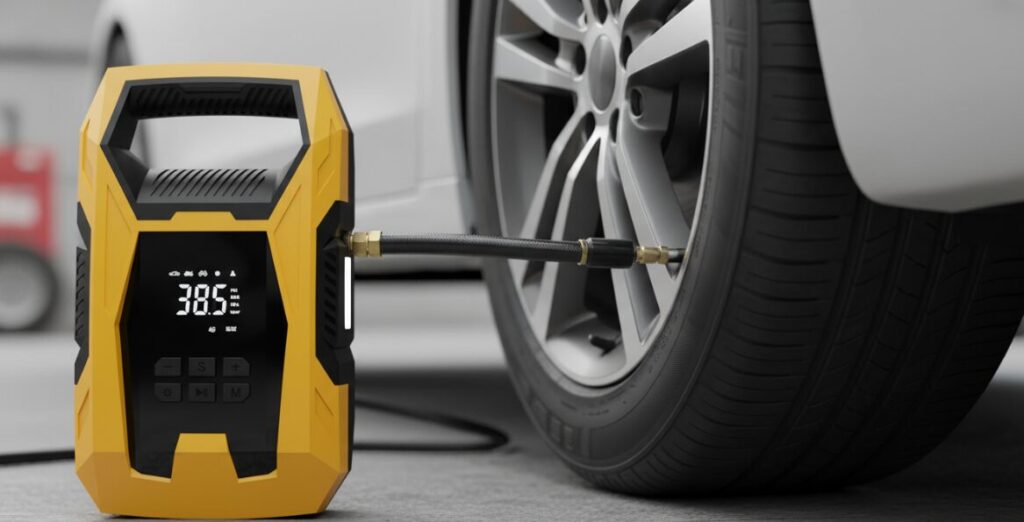
You have to know that the original intention of the car starter battery is to provide a huge current to start the engine instantly, rather than powering electrical appliances for a long time like a power bank. Keeping the engine running ensures that the generator continuously supplies power to the system. Believe me, you definitely don’t want to experience the despair of just getting ready to go on the road when you turn the key and only hear the starter’s feeble “click” twice.
High Voltage Means Faster And Lower Temperature Operation
Many people may not notice that the state of the engine directly determines the performance of the air pump. The secret behind this lies in the voltage difference:
- Flameout state (12.2V): When the car is stationary, a healthy battery voltage is usually only about 12.2 to 12.6 volts. At this voltage, the motor of the air pump will appear “powerless” when facing high tire pressure. Not only is the inflation speed slow, but also excessive heat is easily accumulated inside the motor.
- Starting state (13.8V): Once the engine is running and the generator is involved, the system voltage will instantly increase to 13.8V or even 14.4V. This extra voltage is essential to allow the pump motor to work at optimal speed. The result: significantly faster inflation-allowing you to hit the road earlier-and lower operating temperatures.
Long-term low voltage under the full load of the air pump operation, will make the motor overworked, which will greatly shorten the service life of your air pump.
Protect The Expensive Battery Plate
In addition to the risk of losing electricity on the spot, not inflating the car will also cause irreversible “internal injuries” to the vehicle battery “.
Most household vehicles are powered by ordinary lead-acid batteries (SLI), which are not the kind of “deep-cycle batteries” that can be repeatedly charged and discharged deeply “. Drawing a large amount of electricity from the battery in order to inflate the tire is a deep discharge cycle. This causes the lead plates inside the battery to undergo a vulcanization reaction.
This chemical reaction will slowly “eat” the capacity of the battery over time. Keeping the engine running actually allows the generator to bear the load of the air pump, rather than overdrawing the battery itself, which is very critical to extend the service life of the battery.
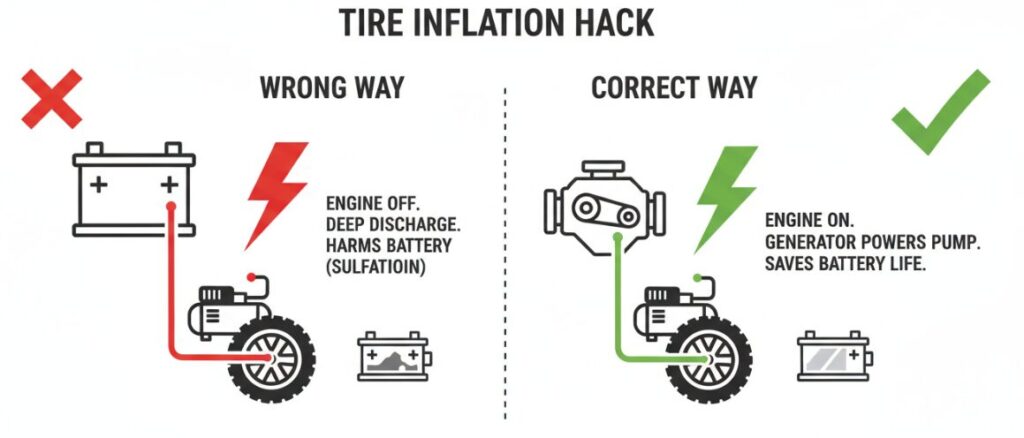
Avoid Carbon Monoxide Poisoning
Although the reasons listed above require you to keep the engine running, safety always comes first.
You must never inflate your car in a closed, even semi-closed garage.
The carbon monoxide contained in automobile exhaust is a colorless and odorless highly toxic gas, which can reach a lethal concentration within a few minutes in a closed space. Even if you leave the garage door open, exhaust can still accumulate in the dead space. In order to use the inflator safely, be sure to follow this procedure: move the car completely out of the garage and park in a well-ventilated open-air driveway. This is the only way to keep your life safe while maintaining tire pressure.
Author: Alex Turner
“Hi, I’m a certified automotive technician with over 10 years of experience specializing in vehicle electrical systems. I’ve seen countless drivers stranded with dead batteries due to improper accessory use. My mission is to help you maximize your car tools’ performance—specifically understanding the difference between 12.2V and 13.8V—while ensuring you prioritize critical safety protocols like carbon monoxide awareness.”